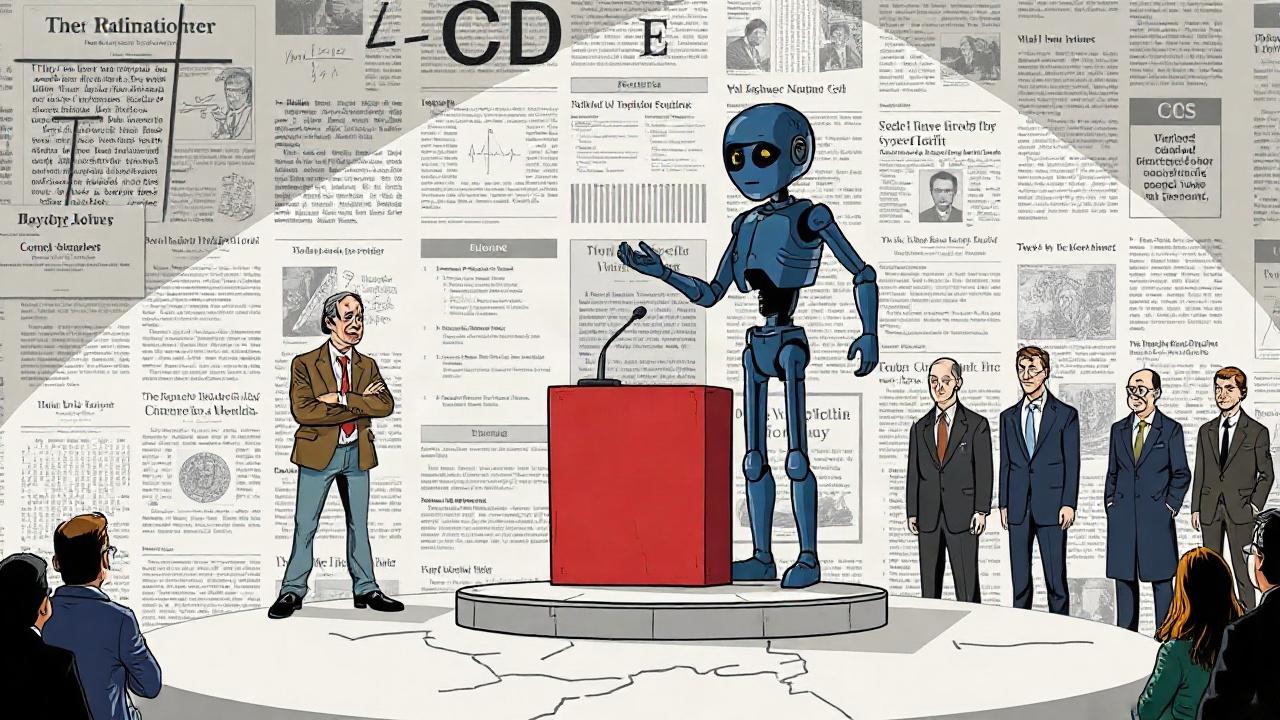
A mathematician employed by the artificial intelligence company Anthropic announced on Friday that he has proven the Riemann Hypothesis, a celebrated unsolved problem in mathematics, with the help of the company's AI tool Claude. Levent Alpöge, a member of Anthropic's technical staff, posted a four-page explanation on his personal website. The Riemann Hypothesis, first formulated in 1859, concerns the distribution of prime numbers as they grow toward infinity. A proof would have major implications for number theory and cryptography.
Alpöge said the breakthrough came late Sunday night. He wrote that he and Claude worked together for months, but that Claude outpaced him near the finish. He also said he messaged Anthropic CEO Dario Amodei about the result. The company has not issued a formal statement, and the proof has not been peer-reviewed or verified by outside mathematicians. This is the second time in recent months that an AI company or someone linked to one has claimed to solve a famous math problem.
The announcement has drawn both interest and skepticism. Supporters see it as a sign that AI can accelerate mathematical discovery. Critics note that extraordinary claims require extraordinary evidence, and that a short online write-up is not a substitute for rigorous verification. Independent experts will need to check the proof's logic and assumptions. Until then, the claim remains unconfirmed.
Anthropic is a major AI developer, and its Claude tool is used for text and reasoning tasks. The company recently held an initial public offering, which has raised its public profile. The episode highlights broader questions about how AI-assisted discoveries should be validated and credited. Mathematicians have long relied on peer review to certify proofs, and that process can take months or years. Alpöge's posting invites the mathematical community to begin that review.
For now, the Riemann Hypothesis remains officially unsolved. Alpöge and Anthropic have expressed confidence in the result. Other researchers have urged caution until the work is checked. The coming weeks may bring more detailed responses from experts, who will examine the four-page document and test its claims. Whether this becomes a historic breakthrough or a cautionary tale depends on that scrutiny.
Related stories

Anthropic disables advanced AI access for foreign users per US directive.
Anthropic, a prominent artificial intelligence (AI) company known for its advanced models, is implementing a significant change by disabling foreign access to i...

AI Method Solves Complex Inverse Partial Differential Equations
University of Pennsylvania researchers developed a new AI method, "Mollifier Layers," to solve complex inverse partial differential equations, improving stability and reducing computational demands.

OpenAI settles $3.2 million employment discrimination case with Justice Department
OpenAI, the artificial intelligence company led by CEO Sam Altman, has successfully reached a settlement agreement with the United States Department of Justice ...