
An international team of physicists has proposed a way to test whether a single clock can experience multiple flows of time at once, a phenomenon that has never been directly observed. The approach uses trapped-ion atomic clocks and a new method for controlling their motion, which the team says improves sensitivity to the effect by 100 to 1,000 times.
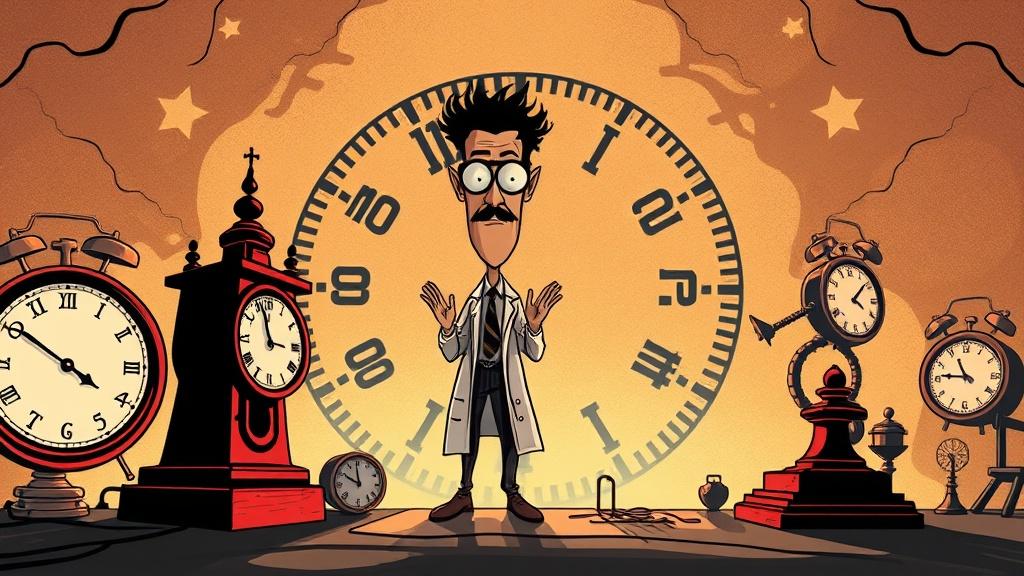
The work rests on two pillars of modern physics. Einstein's theory of relativity shows that time passes at different rates depending on speed and gravity. Quantum mechanics allows a clock to exist in a superposition, meaning its motion follows several possibilities at the same time. Because motion affects the passage of time, those possibilities could correspond to different rates of time within one quantum state.
Atomic clocks measure time through the steady frequencies of atoms rather than mechanical parts. Modern versions are sensitive enough to detect relativistic time differences between clocks separated vertically by just a few millimeters. That precision is what made the new proposal possible, said Joshua Foo, an associate professor at Kyushu University's Institute for Advanced Studies and a lead author of the study.
The team found that a clock's motion becomes entangled with its internal energy. This entanglement causes the clock to lose some of its quantum properties in a way that modern techniques can detect. By controlling the clock's motion more precisely, the researchers argue, the subtle signature could fall within reach of existing instruments.
The study, published in Physical Review Letters, involved researchers from Kyushu University, the Stevens Institute of Technology, the University of Waterloo, the National Institute of Standards and Technology, Colorado State University, and Stockholm University. The work remains theoretical. The next step is to design a working experiment that accounts for real-world disturbances and uncertainty.
Foo said the team is also interested in whether atomic clocks could eventually probe the quantum realm of gravity. If such experiments succeed, they could offer a new way to examine how quantum mechanics and relativity fit together, and provide clues about quantum gravity, the long-sought framework for how gravity behaves at the smallest scales.
Related stories
Quantum Collapse Models Suggest Inherent Uncertainty in Time
Physicists exploring quantum collapse models suggest that time may have an inherent, albeit tiny, uncertainty, potentially linking quantum mechanics and gravity.

New Method Detects Quantum W States for Advanced Computing
Scientists developed a new method to instantly detect quantum W states, a breakthrough that could advance quantum communication, teleportation, and computing.

New Method Creates Powerful Quantum States with Simple Adjustments
Researchers at the University of Chicago developed a simpler method to create powerful quantum states using existing lab equipment, potentially advancing quantum sensing and computing.