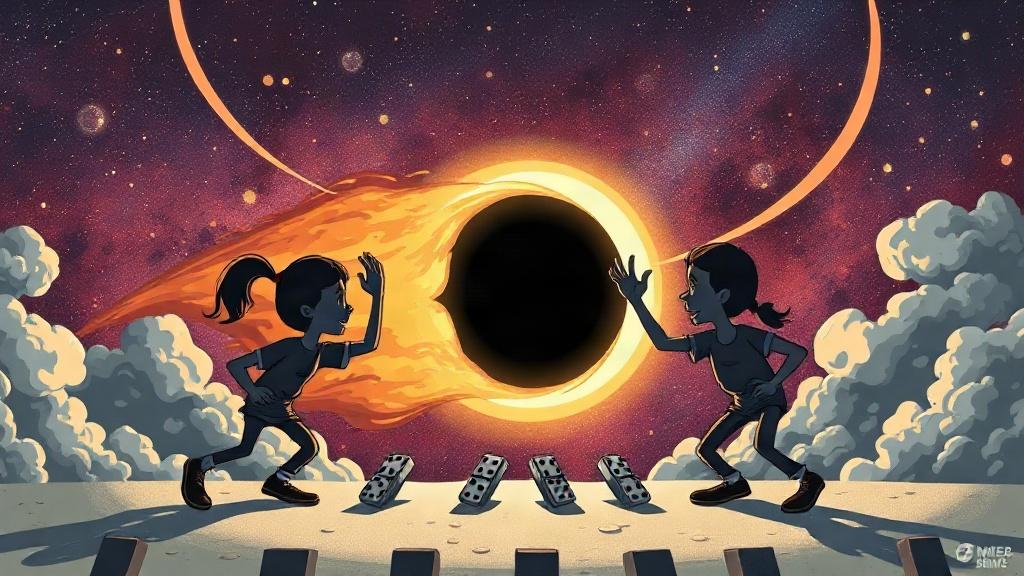
A pair of massive stars may be the hidden source of mysterious gas clouds that help feed Sagittarius A*, the supermassive black hole at the center of the Milky Way. An international team led by the Max Planck Institute for Extraterrestrial Physics traced the clouds to a contact binary system called IRS 16SW, in which two stars orbit so closely they nearly touch.
The clouds in question are compact, dense pockets of ionized gas first spotted in infrared observations over the past two decades. The best known, G2, was identified in 2012 and follows a long, stretched orbit around the black hole with a faint tail of material behind it. A similar object, G1, travels a closely related path. Astronomers later watched gas in G2's tail gather into another compact cloud, and together the objects trace a connected flow known as the G1-2-3 streamer.
Using the SINFONI and ERIS infrared spectrographs, both equipped with adaptive optics for sharper images, the team measured the clouds' positions and velocities through a hydrogen emission feature called the Brackett-gamma line. All three clouds follow orbits with nearly identical shape and orientation. Three unrelated clouds sharing such matching paths would be extraordinarily unlikely, the team reports, pointing to a single origin.
Working backward from the observed motions, the researchers identified IRS 16SW as the likely source. The binary belongs to a disk of young stars circling the black hole clockwise. Computer simulations showed that the stars' powerful winds collide and create a shock between them, compressing gas into dense clumps that can break away and drift inward along the observed orbits. The slight differences between the clouds' paths match the motion of the two stars around each other.
The finding offers a new explanation for how the black hole stays active. Calculations suggest that roughly one Earth mass of gas reaching Sagittarius A* every ten years would be enough to sustain its current activity. Instead of relying only on material already circling the black hole, the system may receive fresh gas from the winds of nearby massive stars.
The work, published in the journal Astronomy, links three processes that are usually studied separately: the evolution of massive stars, the compression of gas, and the feeding of supermassive black holes. It also suggests that stellar activity at the heart of our galaxy may help keep its central giant supplied with matter.
Related stories
Supermassive Black Holes Can Render Exoplanets Uninhabitable
New research indicates that supermassive black holes can render exoplanets uninhabitable by stripping away atmospheres and depleting ozone, even at vast distances.
Dying Stars May Form New Universes Instead of Black Holes
A theoretical study suggests that dying stars might create new universes powered by dark energy, forming gravastars instead of black holes.
Early Galaxies May Be Four Times More Massive Than Previously Thought
Early galaxies may be up to four times more massive than thought due to a hidden population of small stars, challenging galaxy formation theories.