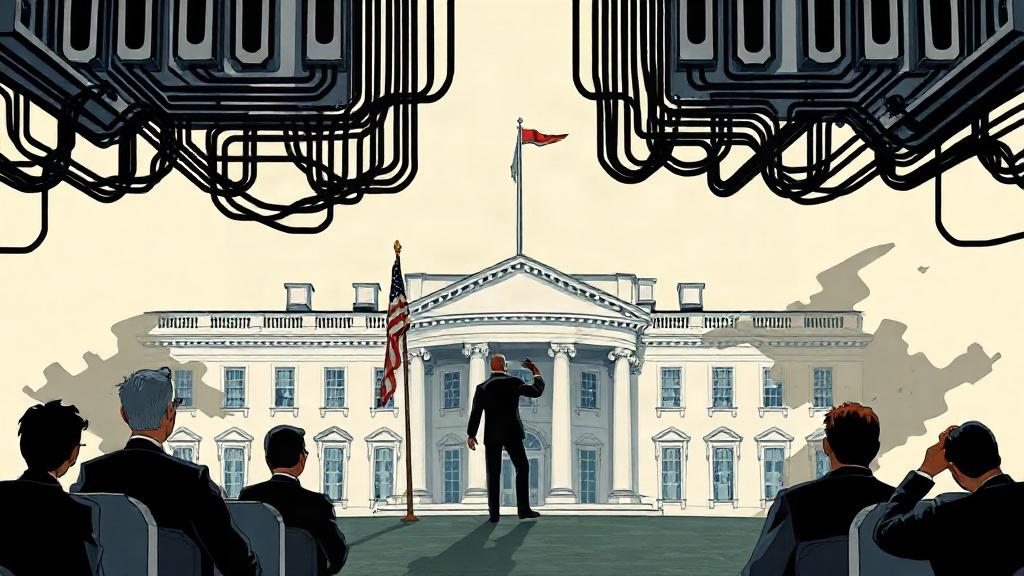
Sean Cairncross, the White House national cyber director, has left his position, a person close to the White House confirmed to Reuters on Thursday. The departure comes just days after a series of technology outages disrupted air travel, banking services and national security systems across the United States, a timing that has drawn attention to the administration's handling of cyber policy.
In the role, Cairncross oversaw cybersecurity policy and strategy across the federal government, coordinating efforts among agencies responsible for protecting both government networks and critical private infrastructure. Kirsten Davies, the Defense Department's chief information officer, will take over the position temporarily, according to the source. The person said President Trump fully supported the decision to remove Cairncross. Cairncross declined to comment on his departure.
Axios first reported the change, citing anonymous officials who said White House chief of staff Stephen Miller pushed for it because Cairncross lacked strong cyber credentials for the job. The account suggests internal concerns about the office's leadership rather than a direct response to the recent outages.
Over the past week, several technology disruptions have occurred. They include a nationwide halt to air travel, a Microsoft outage that affected email services, and a temporary disruption to the National Security Agency's network. The administration has faced criticism over its response to the incidents, with questions raised about coordination and public communication.
The top United States intelligence official said on Wednesday that the disruptions were separate service outages tied to maintenance and technical changes. The official said they were not a coordinated or state-sponsored attack, an assessment aimed at easing concerns that the failures reflected outside interference.
Cairncross was an executive at the Republican National Committee before taking the cyber director role. His permanent successor will need Senate confirmation, a process that could prove complicated because Democrats will control the Senate beginning in January, giving them influence over the nomination and any confirmation hearings.
The two accounts of the change differ in emphasis. One focuses on the firing and the criticism of the administration's response, while the other frames the change as a new appointment following the outages. Both confirm the same core facts: Cairncross is out, Davies is stepping in on a temporary basis, and intelligence officials described the outages as unrelated technical failures rather than an attack.
Related stories

Karoline Leavitt Resigns as White House Press Secretary
Karoline Leavitt is stepping down from her role as White House Press Secretary, an announcement that was officially made on Wednesday. Her departure marks the e...

Navy Secretary replaced; Virginia redistricting vote sparks political debate
The Pentagon announced a leadership change for the United States Navy, effective immediately. The current Secretary of the Navy is departing their position, with their deputy poised to assume the role…
Army Secretary Dan Driscoll resigns; reports cite friction with Hegseth.
Dan Driscoll, the United States Army Secretary, officially submitted his resignation on August thirty-first, two thousand twenty-six. This significant departure...