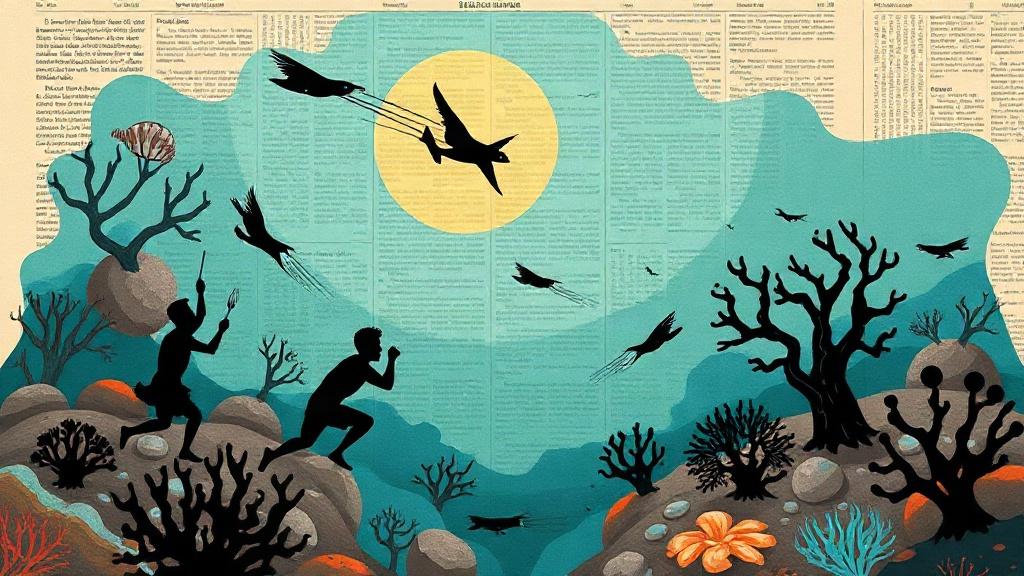
Fossilized coral reefs in the Caribbean could help identify where living corals might survive future warming, according to two new studies from the University of Texas at Austin. The research compared ancient reefs from the Late Pleistocene epoch, 125,000 to 130,000 years ago, with modern reefs in Jamaica to understand which coral species thrived during past warming periods.
The team found that branching corals of the genus Acropora, including Acropora palmata and Acropora cervicornis, dominated ancient reefs but are now largely dead and overgrown with algae at modern sites. Most remaining corals are Porites astreoides, a globular species that recovers quickly but provides less structural habitat. "These big branching species provide a lot of habitat and offshore protection. With that gone, we've lost that function on the reef," said lead author Claire Williams.
Because the fossil reefs now sit above sea level, researchers adapted a standard transect method used for monitoring living corals. Instead of swimming over the reefs, they walked along them, photographing fossils to estimate coral number and distribution. They then compared this data with modern coral surveys.
The second study used ecological niche modeling to predict where Caribbean corals might persist under future climate conditions. By analyzing water temperature and salinity tolerances from fossil corals, including mid-Holocene records from 5,000 to 7,000 years ago, and incorporating climate model projections, the team identified parts of the northern Caribbean, the Florida Keys, and the Yucatan Peninsula as having the best conditions for reef-building species.
However, the researchers caution that fossil data is only a starting point. "The fossil record can improve our predictions and provide best-case ideas of where things might be able to survive," Williams said. "Conservation needs to be adaptive and to keep learning new information." Co-author Rowan Martindale added that protecting reefs is critical for human communities that depend on them for fish and hurricane protection.
The findings were published in the journals Palaios and Conservation Biology. Williams, now a postdoctoral researcher at the Georgia Institute of Technology and Texas A&M University, collaborated with scientists from the Jackson School, the University of the West Indies, the Alligator Head Foundation, and the University of New Mexico.
Related stories
Hard-Surface Feeding Drove Reef Fish Evolution 50 Million Years Ago
A new study reveals that the ability of fish to feed on hard surfaces spurred a significant burst of reef fish evolution around 50 million years ago, leading to increased biodiversity.

Seagrass Survival in Warming Oceans Linked to Sediment Microbes
New research indicates that the survival of seagrass meadows in warming oceans is significantly influenced by the microbial communities within their surrounding sediment, highlighting a critical factor for conservation efforts.
DNA Identifies Extinct Seychelles Crocodiles as Saltwater Species
Scientists used DNA from museum specimens to identify the extinct Seychelles crocodiles as an isolated population of saltwater crocodiles, solving a 250-year-old mystery.